Indigenous Peoples’ Day
October 9, 2028 @ 8:00 AM - 5:00 PM
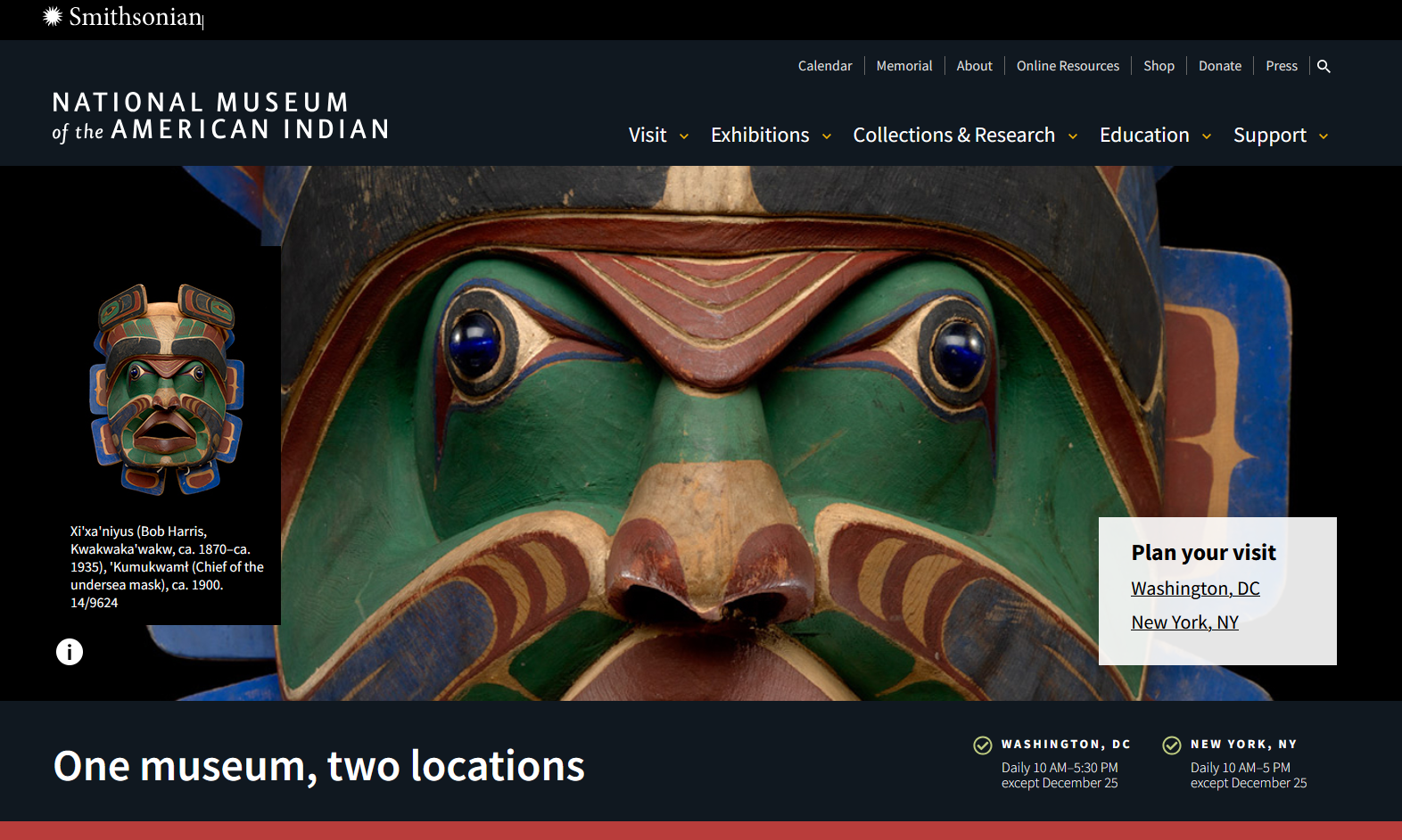
Get TicketsTo find out more about the National Museum of the American Indian or the Kumukwamt, Chief of the undersea mask featured above, go to the National Museum of the American Indian (NMAI) or CLICK HERE
When Is Indigenous Peoples’ Day 2026?
In 2026, Indigenous Peoples’ Day—which celebrates the history and culture of Native Americans—falls on Monday, October 12.
While it’s not an official federal holiday, dozens of states observe Indigenous Peoples’ Day in some way, either in place of—or in addition to—Columbus Day. Many cities and school systems also observe Indigenous Peoples’ Day.
There has been an ongoing effort to formally designate Indigenous Peoples’ Day a federal holiday. “Our country has long failed to recognize and acknowledge its dark history of erasure and harm brought upon the first inhabitants of the Americas,” said California Congresswoman Norma Torres in a 2023 statement.
“By designating Indigenous Peoples’ Day a federal holiday, we take a small but important step toward recognizing the injustices in our nation’s history and uplifting the vibrant traditions, history, and culture of all Indigenous communities—an integral part of the cultural fabric of the United States,” the statement added.
In 2021, President Joe Biden became the first president to officially recognize Indigenous Peoples’ Day on the same date as Columbus Day. Several states recognize both Indigenous Peoples’ Day and Columbus Day on the same day.
Source: Indigenous Peoples Day: Date, Places & Controversy | HISTORY
Kumukwamt, Chief of the Undersea Mask
This mask is carved from western red cedar and is painted in green, red, and black natural pigment paints and two shades of blue made from Reckitt’s laundry whitener. The mask represents ‘Kumugwe´ (Wealthy), the Chief of the undersea kingdom. The eyes are inlayed with round blue trade beads that created a sparkling reflection from the firelight as the dancer slowly movedaround the fire on the dance floor. The eyebrows are thick and represent those of a male, supporting the belief that this is’Kumugwe´ and not his wife. Between the eyebrows there is an overhanging cluster of red frown lines, a signature of the artist; the symbolism of this feature is unknown.
The U-shaped designs on much of the face represent scaling like that of fish or supernatural beings from the sea. Two stylized salmon-trout heads are further representation of the fishlike qualities ‘Kumugwe´ possesses. These ovoid appendages are part of the composition of some character that was originally mounted on top of the head. A large hole drilled through the top of the mask would have allowed the lost prop to twist from side to side or spin around. There is a smaller hole where a string was threaded through to manipulate the object on top. The prop could have been one of many creatures associated with ‘Kumugwe´—a starfish, various fishes or sea mammals, sea birds such as seagulls, or diving birds like loons, messengers between the upper world and the undersea. Scales or gills around the outside rim of the mask are made from a different type of wood. Their artwork does not match the quality of the facial design, and the blue and red shades do not match. This mask has been repaired and made more elaborate than it originally was, most likely by another artist not familiar with the style of the master carver who created it.
There appears to have been a bundle of hair nailed on top of the mask behind the left trout head. The presence of hair suggests that this is a mask for the Dłuwalaxa (Returned from Heaven Ceremony), now called Tła´sala (Peace Dances) by the Kwakwaka´wakw. These dances are considered less sacred than the.Tseka (Sacred Red Cedar Bark Ceremonies), which are only performed in the winter season.
All ceremonial Kwakwaka´wakw masks depict characters from family histories or supernatural encounters. All details on masks have a story and are intentional. Another name for ‘Kumugwe´ is.Tłakwagila (Copper-Maker), as he is the greatest source of the most prized cultural wealth, copper. His house is made of copper, and his wealth is often sought after by legendary heroes in hope of gaining cultural riches. Various sea monsters guard his home under the ocean, and the doorway of his supernatural house is a mouth of one of these fabulous creatures that is constantly opening and snapping shut. In many stories, certain ancestors were able to safely encounter ‘Kumugwe´ and enter his house. After befriending the supernatural being, some young men were permitted to marry one of his daughters and receive his riches as dowry. The killer whales are the warriors of ‘Kumugwe´, and the sea lions are his messengers; seals are his pets and are considered his dogs. All the fishes and supernatural beings from the sea reside in his house and belong to him.
—William Wasden, Jr. (Hiłamas, Kwakwaka´wakw), U’mista Cultural Centre
Source: 
Sponsor
Part of the Smithsonian Institution, the National Museum of the American Indian (NMAI) offers educational resources, exhibits, and events focused on Indigenous cultures and history. They frequently partner with organizations for Indigenous Peoples Day celebrations.
 ATTENDANCE & CANCELLATION POLICY
Methods of Payment:
1. On this website (preferred): Add tickets to the Shopping Cart below and check out using PayPal: You DO NOT need to have a PayPal account or create a PayPal account to make payments on this website. You can pay with your credit or debit card: select the option to pay with credit card follow the prompts to check out..
2. Checks payable to: ‘Careprovider.Org’
Please ensure you note the participant’s name and course name on the check.
Mail to: 2648 E Workman Ave, # 308, West Covina CA 91791